
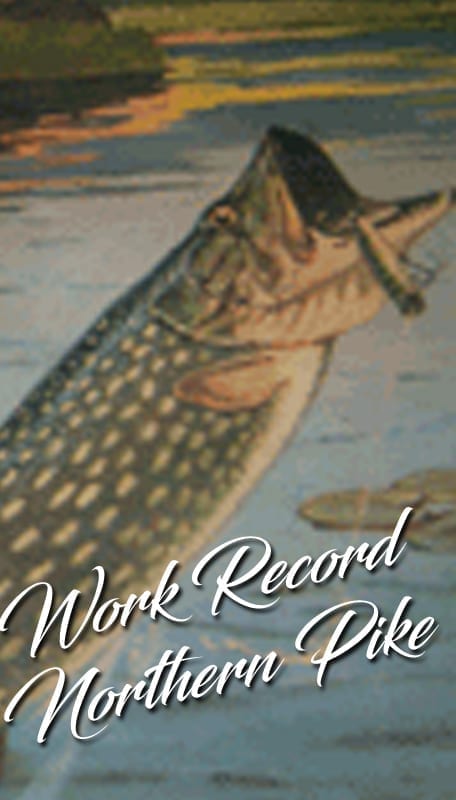
Great Sacandaga Lake World Record Northern Pike Caught in 1940
 During morning of September 15th 1940, Peter Dubuc cast a 6″ long, wooden, flap tail plug lure with 2 treble hooks on a 12 lb test with a 48” bronze leader into the waters of a quiet bay in the Great Sacandaga Lake. Not a man to “ just fish for whatever he could catch” Dubuc’s focus was pike. But he may not have expected to catch what hit the line. The battle ensued for an hour and ended with Dubuc landing a world record Northern Pike. That world record held for almost 40 years.
Almost 70 years later Gail Dubuc Freeman was searching the internet for stories about her fathers famous catch and happened upon the website visitsacandaga.com which had made mention of her father and the pike. Upon further communication with Freeman she related that Outdoor Life magazine reporter Ben East in 1959 spent a few days with Dubuc. Gail provided a copy from the original magazine of the story written by Ben East, as told to him by Peter Dubuc, it reads as follows:
“I’d worked back and forth over prime pike ground for over an hour and a half without a strike, something that rarely happened to me in those waters. Now, approaching an area I knew was spiked with stumps , I revved the outboard a bit to bring my plug up where it wouldn’t snag.
 The water was only 9 or 10 feet deep. The drowned stumps left when the timber was cleared before the valley was flooded (1930) were a favorite hang out of big Northerns. If couldn’t raise a pike here I might as well quit. But I knew I wouldn’t do that for a while, no matter what happened.
I passed over the first of the submerged stumps with 75 yards of line out. When I was about that far beyond the stumps, a fish smashed into my lure like a starved cat taking a mouse. The speed of the boat and the savagery of his rush drove the hooks all the way in, and almost before I knew I had the strike the surface of the water boiled like someone had tossed a small hand grenade.
I was using my standard trolling rig, a 6 foot rod with enough backbone to handle the big ones and 300 yards of 12 lb. test mounted on the trolling wheel. For a minute the fish fought like a wild steer on a rope. Then quieted down and came along the way I wanted it to.
 I brought him in within 25 ft of the boat before he changed his mind. He didn’t make much of a fuss about it, just swapped ends and lit out. I could tell by the feel of him I’d better let him run. I set the drag on the wheel up to all I thought it could stand, and he walked of with 115 ft of it as easy as a breeze carrying thistledown. Then he came to the top. Breaking water three times coming far enough out for me to get an eyeful, as near as I could tell there was no less than 4 ft of him. He took off in a big circle but I pressured him in close enough for a good look. He was a whopper sure enough. When he whipped around once more and headed for the far side of the reservoir, I gave him all the line he wanted without any argument. The only way I’d win this fight would be by outlasting him. With the 48” bronze leader between the plug and the line there was no chance he could sever that. If I could keep him away from the stumps and snags chances were good I’d come out on top.
 I set the drag as tight as I dared to keep him working every minute, and edged the boat toward deeper water. The pike bucked and thrashed and took line, and I won it back only to lose it again. It was 45 minutes before I saw any sign of let up.
He was beginning to play out at last. Another 10 minutes and I had him close to the boat. But I knew he wasn’t quite ready for the taking as he was still belly down in the water. You don’t make a final pass at a pike of that size until he rolls over.
 This fish moved like forked lightning flailing end for end and flashing under the boat with a wallop that knocked a bucket of water in my face. But I was ready for him. I gave what I had to, turned him and made him come into the open then punished him with the rod until I saw his long white belly roll to the top. He was ready now. I never gaff a pike. If you have the patience and the know-how to tire your fish there’s no need for a gaff. I always release everything except my biggest Northerns, so I like to bring them in unhurt. I learned a long time ago that when a big pike gives up, you take him right then. Grant him a minute to get his second wind and you’ll have half the job to do all over again, maybe lose him.
So the second this lunker turned over I moved fast. I reached for his eye sockets with my thumb and middle fingers holding him as hard as I could then with all my strength hauled him aboard, then looked at my watch. It had been an even hour to turn the trick. He was the biggest pike I ever caught but right then I didn’t know exactly how big.”
 Dubuc went ashore and had the fish weighed at what his daughter Gail remembers as Pelchers store in Benedict, northeast of North Broadalbin. The 1959 Outdoor Life Article reads as follows:
“The pike was 52 1/2” long and 25” girth. His weight was a record smashing 46 lbs.2 oz. We weighted him twice. Once in the town of Broadalbin, then again in Albany on beam scales both times. It was soon established I’d taken the biggest northern pike ever landed on hook and line anywhere on earth, a world record that still stands 19 years later.
I don’t happen to care much for mounted fish and at $1 an inch, the rate local taxidermists quoted me, I couldn’t see a $52.50 investment in this one. So I gave the fish away. I’d had the fun of catching him and the satisfaction of setting a world record that was all I wanted and more.”
Dubuc went ashore and had the fish weighed at what his daughter Gail remembers as Pelchers store in Benedict, northeast of North Broadalbin. The facts as they are stated in the 1959 Outdoor Life Article reads as follows:
 “The pike was 52 1/2” long and 25” girth. His weight was a record smashing 46 lbs.2 oz. We weighted him twice. Once in the town of Broadalbin, then again in Albany on beam scales both times. It was soon established I’d taken the biggest northern pike ever landed on hook and line anywhere on earth, a world record that still stands 19 years later.
I don’t happen to care much for mounted fish and at $1 an inch, the rate local taxidermists quoted me, I couldn’t see a $52.50 investment in this one. So I gave the fish away. I’d had the fun of catching him and the satisfaction of setting a world record that was all I wanted and more.”
Also in 1940 Peter caught the record tying New York State Largemouth Bass from the Great Sacandaga, and as of the year the article was written,1959, still held that honor.
 Catching the bass was no accident. He was trolling over a cobblestone bottom that morning to intentionally catch one. The water was about 7 feet deep, shallow enough to see bottom. The largemouth tapped his line and made a second pass and latched on hard. It took ½ hour to subdue the bass.
His rule of baits to catch northern was simple. Anything that acts and looks like a disabled smaller fish will do the trick. He had caught them on bait he made by threading a wire leader through a hotdog, attaching hooks on each side, and added two yellow thumbtacks for eyes. And he’d heard of other people fooling them with a carrot, a piece of flattened beer can, an empty 30/30 cartridge and even a discarded toothbrush.
Methods of choice he preferred casting to trolling. But having a plate in his right shoulder, from a basketball injury, handicapped him severely as a caster. He did pretty well side winding, but even that way his arm played out quickly. For casting he used use a 4 1/2’ rod a good reel and 100 yard. of line and usually a 10 lb test. For trolling his preference for the rod was 18 inches longer and the line 3 times as long . And 48 inch metal leader was a must if you’re after pike.
 The water depth pike frequent depends on a lot of factors. In NY they spawn in late April when pike season opens May 1st they’re still up in the shallow water along the shore. Then in early May he’d observed where some would even come up to sun themselves on the surface. He had caught some with surface plugs. As the summer heats up they are found in deeper water. But in the cool of the day morning or evening pike will come in close in water 10’ deep or less.
He also notes that you have to go to the pike and not expect them to come to you. For mid-day summer fishing they may be found around 15-20 feet down. He would use a either a deep running or a surface plug with a dipsey sinker of the desired weight tied to the line about 8 ft ahead of the lure. He felt that the daylight hours during the dark- of -the -moon period produced peak activity.
The best place is around stumps or weeds, drowned fallen treetops, submerged brush, and under clumps of lily pads. He always got as close as he could to these potential snag areas his philosophy being “You can lose plugs by sweeping stumps, but you also take pike“.
 His favorite season was September. Late August also being good. Then early May. July was at the bottom of the list. His reasoning being that he believed Northerns shed their smaller teeth and would go off their feed.
Two things he couldn’t stress enough were to never hurry a lure. Trying to mimic a smaller distressed fish takes time. His favorite method was to “drift troll“. Letting the breeze or current push the boat along. The other was to know the area you fish in intimately . It’s bottoms and depths where sand bars and rocks and weed beds are located. Study the shoreline stay away from rocky shores and bottoms or sandy beaches. Pike prefer marshy shore and weedy floor. The mouths of creeks are often a prime place to look.
 The search for more information about Peter Dubuc’s world record pike began on the internet with the finding of discrepancies so to say. To borrow the phrase: “ In time, history becomes legend, legend becomes myth.” And if there is no one to support the facts, liberties are taken to relate unknown information however accurately or inaccurately someone chooses.
It has been written that Dubuc didn’t catch the world record fish at all. That he found it, either on the shore or in the water, choking to death while trying to eat another fish. This story may have gotten started from another catch of Dubucs which was a 28 lb pike:
 “The pike that taught me my most unforgettable lesson about his kind was a 28 pounder that wasn’t exactly starving when he took my plug. He had a 10 inch walleye in his stomach an 8 inch walleye halfway down and a 6 inch shiner in his gullet. The tail of the shiner was still sticking out of his mouth. There wasn’t any room for it to go any farther. Yet he walloped my lure as if he’d been fasting for a week.”
Why are there no photos of the world record pike? No one knows why photos of the pike don’t exist. But the catch was verified and recorded in Albany. And a reproduction using length, girth, and weight has been made.
Why he didn’t have the pike mounted? It would have cost $52.50 to have it mounted. That doesn’t sound like a lot today especially for a world record pike. But in years just previous to 1940, during the depression, average annual salaries were about $1900.00 to $2,500 a year
(if you were lucky enough to have a job). To compare costs, the same fish would have been upwards of $450.00 to $650.00 today. That was almost the cost of a car back then. He also noted that he didn’t care much for fish mounts. Pike caught through the years: 1936 he caught 36 pounder best of the year in NY, in 1937 a 32 pound 10 ounce , in 1938 a 35 pound 6 ounces, set no records in 1939, 1940 he caught the world record pike and tied the Largemouth Bass record in NY, in 1941 a 33 ¼ pound pike and none of these were mounted.
A 46 pound 52 ½ inch fish on a 12 pound test line? Dubuc was a sportsman. He enjoyed the time and technique used to catch a fish. He didn’t hurry through the process. And a lighter line gave him the challenge.
Years differ as to when the World Record Pike was caught in Germany that surpassed the Dubuc Pike those years are: 1979 and 1986.
To show how easily the facts can be misinterpreted and continue on in time the first article of this story noted a 6 foot long lure. It wasn’t 6 foot it was 6 inches.
It’s been noted that this accounting of Outdoor Life article may vary from other interviews covered. Peters daughter Gail Freeman is of the opinion that the Outdoor Life article is the most accurate account of Dubuc’s pike legacy. Ben East of Outdoor Life magazine spent at days with her father, more time than any other interviewer did.
As for her father eating the world record pike. She states “He didn’t like pike it was too boney for him. He gave all his pike catches away to friends”
Female pike are the larger of the species even though Dubuc refers to the fish in his story as “he” the world record was most likely female.
Dubuc studied pike in shallow depths and related more information about pike behavior: “You have to put your lure with easy reach. For all their assassins ways they won’t make long stalks. I’ve watched pike prowling a shallow bay on windless days at dusk when the water was like glass. They are merciless and deadly, but they are also lazy. Anything that came close enough for a sudden swift pounce they took including my plug if I dragged it past within a yard of them. But if I kept it 12-15 feet away they ignored it . Near-sighted? I don’t think so. Just lazy.” He was also convinced they didn’t feed at night. And weather didn’t matter rain or shine.
One late August morning he had exceptional luck landing five pike ranging from 22 to almost 35 pounds. The 22 pounder proved to be the toughest. He caught the pike white casting. The fish struck during a long retrieve and then swam around a drowned tree stump. He was pretty sure he was going to lose him. But kept the line tight and rowed around the stump to pull the pike into the clear. The pike came to the top like a Tarpon. Waltzing all over the lake coming out of the water about every 10 feet skipping and tail dancing, rolling on the leader, trying every trick it knew to throw the hook. The pike jumped for 30 minutes but then finally lost steam and the rest was easy.
Peter Dubuc grew up in Winooski Vermont in 1892 the youngest of 9 children. His twin brother died at age 16. Taught at a young age to fish by his father his first fishing foray was with a railroad spike and hand line in Lake Champlain. His first significant catch was an 11 pound pike. His sister was an avid angler too. After leaving school he moved to Schenectady and as a young man to worked for New York Power and Light which later became Niagara Mohawk (and now is National Grid) until he was forced to retire in the 30’s due to a heart attack
In 1935 he bought the house on Benedicts Bay on what was called then the Sacandaga Reservoir. The house became a resort where people could stay, a boat livery, and was a fishing guide. For 10 years he fished the Sacandaga almost everyday spring through fall. He got to know it so well he’d take bets that he could guess within two feet and rarely lost. In 1945 the house by the bay and the boat livery that housed 10 boats burned. It was a total loss. The land was sold and he moved to Albany. But he regularly returned and rented a boat to fish the Sacandaga.
Meeting with Gail Dubuc Freeman, she talked about fishing trips with her father on the Sacandaga when she was very small: “He would get me up at 3 am. He believed in getting to the lake early and the Sacandaga was an hour drive from Albany. You never knew what you would find in the bathroom on those mornings as he would get different kinds of live bait the night before and keep it in the bathtub. And there they would be, minnows, bullheads, whatever, swimming around in the tub with faucet water trickling”.
She added “After landing the record pike things started arriving in the mail. Fish poles, plugs, reels, all kinds of things from company’s wanting him to try their products so they could use his name for endorsements”. When sorting out her fathers things her brother got the rods, reels, and fishing gear. “But I wanted the lure”. She also brought newspaper clippings, photos including one of Peter’s sister ice fishing, the framed artwork by Lynn Bogue-Hunt and the lure her father used to catch the World Record Pike. Peter passed away in 1970 at age 80.
Gail had sent a photo before the meeting of a sign that some people may remember along the roadside by Route 30 in Cranberry Creek a sign that advertised for a place called “Fisherman’s Rest” which in later years was the “Sportsman’s Lounge” and is now Lanzis on the Lake. The Fisherman’s Rest sign was testament to Dubuc’s World Record catch and included a painted pike, her fathers name, the date, weight, and length of the pike that was caught. The actual catch was made near Benedict on the Broadalbin side of the lake.
Gail added this“ The world record pike was most likely first weighed at Pelcher’s Store as that where he went with most all of his catches” He was not aware he had caught a world record and had told her he didn’t have it mounted as it would have cost too much money. These were the Depression years. “He didn’t have any of the fish he caught mounted. Mostly he shared his catches with friends”
“A 12 pound test was common weight for him” Gail confirmed “He said that you can catch the big one with any weight and plug if you know how to play them out. Most fishermen try to bring them in to soon and their line breaks.”
The lake was only ten years old at the time the record pike was caught. Going back in early history to when the Great Sacandaga was a river, 14,000 acre wetland area known as the Vlaie (Vly) was swallowed up by the newly formed reservoir. It was a fisherman’s paradise that was a home to pickerel, trout, walleye bass and pike.
Dubucs 46-pound, 2-ounce monster reigned as the planet’s biggest pike until a 55 pound pike was caught in Germany. The Dubuc pike caught in the Great Sacandaga Lake still holds the record for the largest pike caught in the USA.
Keeping the Sacandaga an “anglers haven” has been the focus of the Great Sacandaga Lake Fishing Federation (GSLFF) a federally recognized not for profit corporation dedicated to the preservation and enhancement of the fishery of the Great Sacandaga Lake. All officers and members work is done on a volunteer basis. Formed in 1984 and was originally comprised of various fish and game clubs, some of which are still members of the Federation. In the 1990’s, membership was opened up for all who hold an interest in this great resource. The GSLFF has stocked 85,860 fish at a cost of over $380,000.00 for the last 20 years. The organization yearly stocks game fish in the lake. For more information visit www.gslff.org.
By L.L.Decker
